La Calabaza / la lampara para ahuyentar los malos espíritus
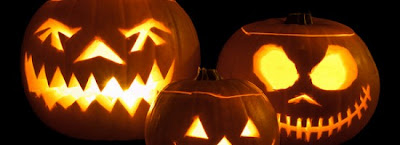
La costumbre de ahuecar y tallar una calabaza para convertirla en un farol llamado Jack-o-lantern tiene su origen en el folkclore irlandés del siglo XVIII. Según se cuenta, Jack era un notorio bebedor, jugador y holgazán que pasaba sus días tirado bajo un roble. La leyenda cuenta que n una ocasión, se le apareció Satanás con intenciones de llevarlo al infierno. Jack lo desafió a trepar al roble y, cuando el diablo estuvo en la copa del árbol, talló una cruz en el tronco para impedirle descender. Entonces Jack hizo un trato con el diablo: le permitiría bajar si nunca más volvía a tentarlo con el juego o la bebida.
La historia dice que cuando Jack murió no se le permitió la entrada al cielo por sus pecados en vida, pero tampoco pudo entrar en el infierno porque había engañado al diablo. A fin de compensarlo, el diablo le entregó una brasa para iluminar su camino en la helada oscuridad por la que debería vagar hasta el día del Juicio Final. La brasa estaba colocada dentro de una cubeta ahuecada "llamada nabo" para que ardiera como un farol durante mucho tiempo.
Los irlandeses solían utilizar nabos para fabricar sus "faroles de Jack", pero cuando los inmigrantes llegaron a Estados Unidos advirtieron que las calabazas eran más abundantes que los nabos. Por ese motivo, surgió la costumbre de tallar calabazas para la noche de Halloween y transformarlas en faroles introduciendo una brasa o una vela en su interior. El farol no tenía como objetivo convocar espíritus malignos sino mantenerlos alejados de las personas y sus hogares.
HAPPY HALLOWEEN !!!!
BUUUHHHHHH....!!!!!
10 Halloween Books Your Kids (and You!) Will Love ‹ Suburban Turmoil
Fill a small cup with 30 mL of hydrogen peroxide (12%).
Add a squirt of dish soap to your hydrogen peroxide.
Mix in some some food coloring to give your reaction a bit of effect.
Open up the top of your jack-o-lantern and carefully lower the cup of mixture into the jack-o-lantern. Don't tip it over or you'll have to start over from the beginning.
Now you're going to need to create your Elephant's Toothpaste catalyst. Mix an entire package of dry yeast with 4 tablespoons of very warm water in a small plastic cup. If the mixture is too thick, like a paste, add a little more warm water to thin it out.
Pour the yeast solution into the cup and quickly replace the top of your jack-o-lantern. It may take a few seconds, but once the reaction starts the result is well worth the wait.
How does it work?
In this reaction, you've got a catalyst in the form of your yeast solution. This catalysts works to release the oxygen molecules that are contained in the hydrogen peroxide. Those molecules are being released as the hydrogen peroxide breaks down into two components, water (H2O) and oxygen (O2), from the addition of the yeast catalyst. The foam is the molecules of oxygen being made into tiny bubbles as they pass through the soap that your added. In addition, as the bonds break between the H2O and O2, they release energy in the form of heat. Try performing the experiment without the pumpkin and feel the sides of the cup. They're warm!
Mummy Halloween Craft For Kids - No Time For Flash Cards
www.notimeforflashcards.com
Simple and almost mess free! Cute Halloween mummy craft for kids,The scary skeleton
This just an example of a Grade 3 (8 year olds) chant, composed by the pupils, (with a little help from the teacher, of course!).
One, two, three, four
This is a hat, this is a hat,
What do you wear on your head?
A hat!
These are two gloves, these are two gloves,
What do you wear on your hands?
Two gloves!
Look at these shoes, look at these shoes,
What do you wear on your feet?
Brown shoes!
…
http://www.lyricstraining.com/search?qry= http://audioboo.fm/ We are a mobile & web platform that effortlessly allows you to record and share audio for your friends, family or the rest of the world to hear.
http://www.teachertrainingvideos.com/elllo/index.html First Certificate audio recordings
BE HAPPY!!!
Here are just a few of the reasons why I love teaching with music:
Songs are memorable. Kids remember them long after they leave the classroom.
Songs are a great equalizer. Everyone can participate in one way or another. This makes them great for mixed-level classes.
Songs improve pronunciation and intonation.
Songs introduce vocabulary and grammar without learners even realizing it.
Songs are engaging. They grab kids’ attention.
Songs can be used many times. They provide valuable repeated exposure to the language.
Songs let all learners participate in a way that’s comfortable for them. Some kids will just listen, others will listen and gesture, and some will sing along. All of the children will benefit.
Songs are flexible. They can be used as a primary or supplementary activity, or they can just be played in the background.
Songs allow children to get involved. They can use their bodies to learn through gesture and dance.
Songs are easy to combine with other activities.
Songs are fun and positive. They create a great atmosphere for learning.
Wisdomap helps you to organise your thoughts in a powerful mind map format, and allows you to attach notes, videos, pictures, links and files to your mind maps.


 La costumbre de ahuecar y tallar una calabaza para convertirla en un farol llamado Jack-o-lantern tiene su origen en el folkclore irlandés del siglo XVIII. Según se cuenta, Jack era un notorio bebedor, jugador y holgazán que pasaba sus días tirado bajo un roble. La leyenda cuenta que n una ocasión, se le apareció Satanás con intenciones de llevarlo al infierno. Jack lo desafió a trepar al roble y, cuando el diablo estuvo en la copa del árbol, talló una cruz en el tronco para impedirle descender. Entonces Jack hizo un trato con el diablo: le permitiría bajar si nunca más volvía a tentarlo con el juego o la bebida.



 One, two, three, four


